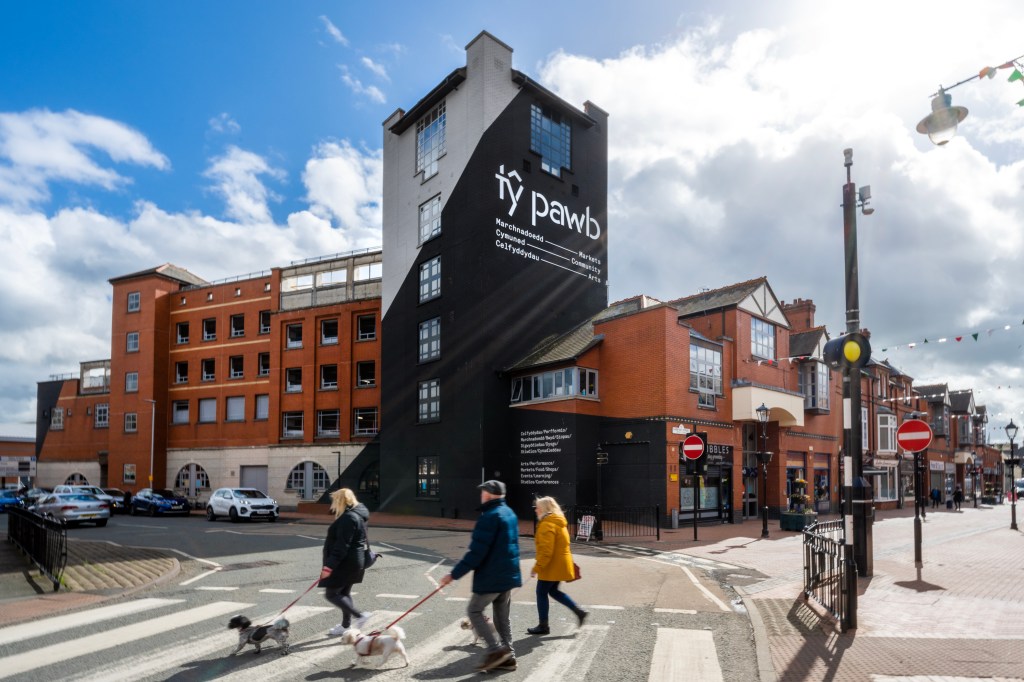
I’m currently co-Chair of Tŷ Pawb’s Advisory Board. Welsh for “everyone’s house”, Tŷ Pawb is a genuinely hybrid space, merging what were once three separate identities: a market, a gallery, and a multi-storey car park. Under the leadership of Creative Director Jo Marsh, it has become a place where the historic heritage of Wrexham as a market town meets a living, socially engaged art programme, played out across shops, a food court, a theatre space, two galleries, and a rooftop garden.
The building opened in 2018, backed by Wrexham County Borough Council, Arts Council Wales, and the Welsh Government, bringing together two previously unrelated sites: the ageing 1990s “Peoples Market,” which had been earmarked for demolition, and Wrexham Art Centre, whose 1970s premises had never secured funding to expand. Working with architect Sarah Featherstone of Featherstone Young, the solution was to avoid separating art and commerce altogether. Instead, a single flexible “town square” was created, sharing the physical footprint of the old market and car park with a dedicated art space — what Featherstone called a “baggy space,” designed for constant reconfiguration between stalls, food outlets, performances, exhibitions, and learning activities.
That architectural flexibility has translated into something more significant: a place where the usual boundaries between art, commerce, education, and community life become porous. Traders, artists, educators, and residents mix in ways that feel more like ongoing, full-scale collaboration than abstract proposals for change — underpinned by a commitment to play as a way of working across differences of age, gender, ethnicity, sexuality, and class.
Tŷ Pawb also sits at a wider civic crossroads. It was conceived partly to reconnect Wrexham’s traditional town centre with the newer Eagles Meadow shopping development, helping to reactivate a town centre shaped by deindustrialisation and the aftermath of the 2007 financial crash. Early public workshops, run with a graphic design agency and open to traders, artists, politicians, and residents, shaped both the building’s Welsh name and its ongoing programme of events, exhibitions, and community initiatives addressing health, sustainability, education, and identity.
At the heart of this work is the Useful Art Space (Lle Celf Ddefnyddiol), a space for play, dialogue, and learning as much as looking. It has hosted projects from community photography and family art sessions to Bom Dia Cymru, welcoming Wrexham’s Portuguese community, and Make Yourself at Home, in which artist Ibukun Baldwin worked with refugees and asylum seekers to develop textile, ceramic, and design skills — producing goods that could be sold in the market itself.
Much of this is guided by Marsh’s concept of “Taking it to Market”: using creative skill as something to be traded and exchanged, and using art as a practical tool for social change rather than an end in itself. This thinking also shapes the Creative Car Park (Maes Parcio Creadigol), which has transformed the rooftop car park into an experimental green space for workshops, training, and collaborative building projects — linking Tŷ Pawb to wider networks of community and creative practice, locally and beyond.
Together, these strands make Tŷ Pawb a genuine working example of how art, commerce, and community can be reimagined side by side as Useful Art in action.


You must be logged in to post a comment.